CPSE Accreditation
Accreditation support for fire departments.
Two documents carry most of the weight of a CPSE submission: the Community Risk Assessment and the Standards of Cover.
Both are built from years of maps, tables and 90th-percentile performance figures.
Darkhorse generates those from the CAD and RMS data you already keep.


Find your place
You have thought about it and put it back down.
This is the most common place to be. There are more than 100,000 fire agencies worldwide and 335 of them are accredited. Almost every one of those 335 spent a stretch here first, looking at the requirements and deciding this was next year’s problem.
- 01Read CPSE’s Self-Assessment Model and the Community Risk Assessment / Standards of Cover model. Both are published and free.
- 02Find out what condition your CAD and RMS data is actually in. This decides your timeline more than budget or headcount does.
- 03Register with CPSE when you are ready. Registered status is $700, lasts three years, and renews as many times as you need.
- We run three to five years of your CAD and RMS data and show you your real 90th-percentile performance before you commit to anything.
- That baseline tells you whether your CRA/SOC is a six-month job or an eighteen-month one, which is the number you actually need to make the decision.
You do not need clean data to begin. You need to know what your data looks like.
The requirement map
Exactly how Darkhorse can help.
A CPSE submission breaks into thirty pieces across the Community Risk Assessment, the Standards of Cover, the self-assessment manual and the annual reporting that follows.
Use the explorative tool below to see the deliverables Darkhorse Emergency can help you produce.
Nine sections of the CRA are quantitative, built from maps, demographic layers and hazard data rather than narrative.
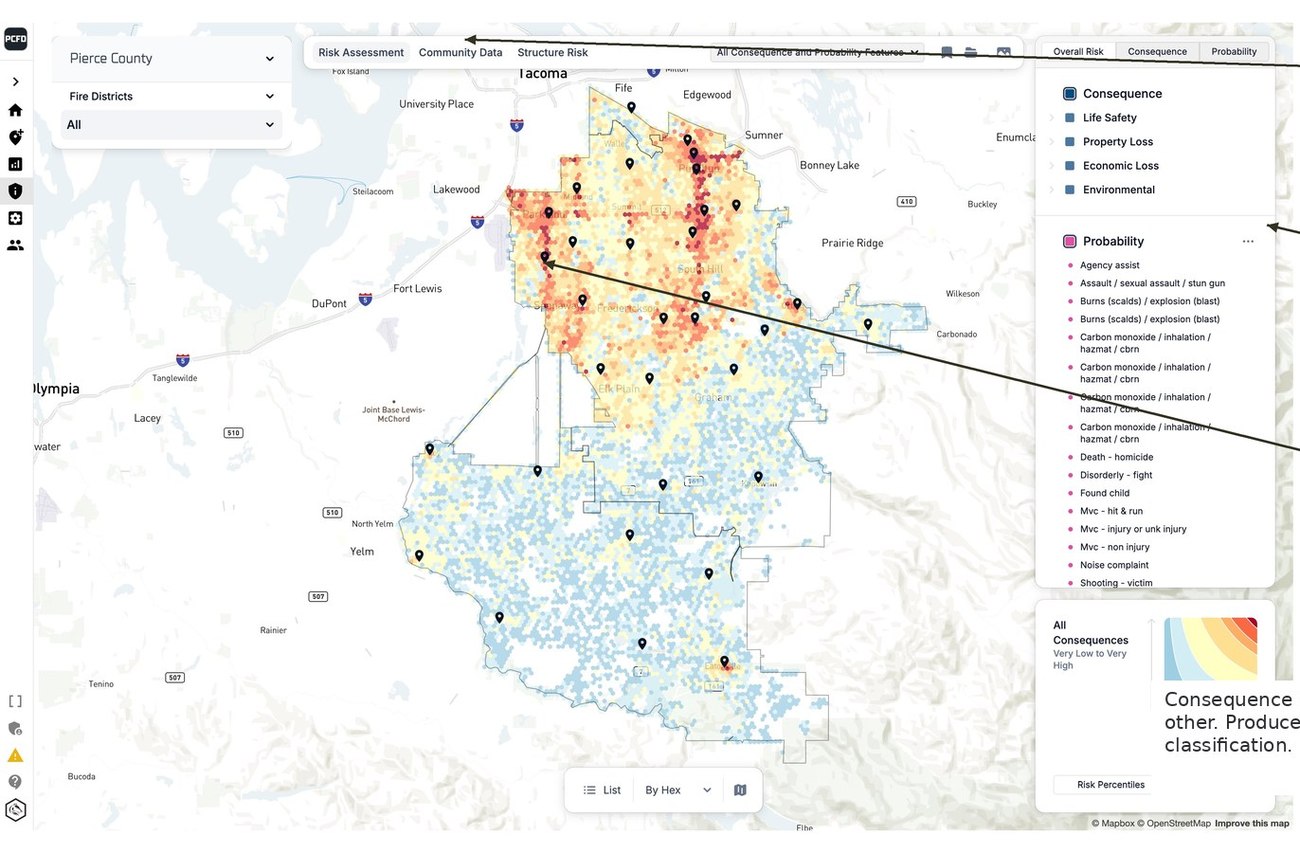
Service area description and station coverage maps
Pulls the overall service-area map with station pins and run-box boundaries for inclusion in the CRA.
Does this make sense for your department?
01
A budget ask with a number behind it. You state the service level you intend to deliver, measure whether you deliver it, and publish the gap.
02
A standard that is sustainable. A five-year cycle with an annual report keeps the improvement loop in the organization rather than in one person’s tenure.
03
A short list that is easy to check. CPSE publishes every accredited agency, so being on it is a fact a council, an insurer or a recruit can verify.
SOME NUMBERS
11
Categories in the self-assessment model
266
Performance indicators in the 11th Edition
335
Agencies accredited worldwide
14%
Of the U.S. population is covered by an accredited agency
17%
Of the Canadian population is protected by an accredited agency
Figures published by the Center for Public Safety Excellence. The 11th Edition takes effect for agencies appearing before the Commission from 2027.
CHALLENGES
01
The gate before the gate
CPSE will not move you to Applicant status until you have a completed Community Risk Assessment and Standards of Cover, a Community-Driven Strategic Plan, and work under way on Categories 1 through 3. Most departments discover the CRA/SOC alone is a year of analysis, before the accreditation clock has even started.
02
Data is the first obstacle, and CPSE says so
CPSE’s own chief executive names data as the biggest obstacle for departments working towards and maintaining accreditation. Not indifference to it. The work of acquiring it, compiling it, and being able to tell the difference between a bad number and bad performance.
03
The 90th percentile is not in your records system
Alarm handling, turnout, travel and total response, split by program and by risk tier, at the 90th percentile, across three to five years, against benchmarks. Most RMS reporting hands back an annual average and leaves the rest to a spreadsheet nobody wants to own.
04
Someone owns it on top of their real job
The accreditation manager is rarely a full-time role. Peer review is two to three years of sustained work, and momentum is the first thing to break when the person carrying it is also running a shift, a budget, or both.
05
It does not end at the site visit
Accreditation runs five years, with a compliance report due to CPSE every year in between, and re-accreditation at the end. A one-time consulting deliverable leaves you rebuilding the same figures by hand, annually, forever.
So
Four of those five are data problems.
And a data problem has a supplier. The slowest part of a CPSE submission is the part that comes out of your CAD and RMS, which means it can be produced rather than assembled. Your people keep the part that needs their judgment: the policy, the governance, and the narrative that explains your community to a peer team.
TESTIMONIALS

Carly Shears
CRR Division Manager, Meridian Fire Department
On the CFAI accredited list
Meridian Fire Department
Idaho · career department · population 142,830 · ISO Class 2
Meridian is one of the 335 agencies CFAI has accredited. Carly Shears runs their community risk reduction division, the work Category 5 asks about, and the analysis underneath it runs on Darkhorse.
Next step
Tell us where you are. We will tell you what it takes.
A first call runs about thirty minutes and covers three things: what condition your CAD and RMS data is in, which CPSE stage you are actually at, and what a realistic timeline looks like from there. If you already have a consultant engaged, we work alongside them.